
Why Jesus Matters
Almost everyone has heard the name Jesus.
But many people know only pieces of His story.
Some know Him through childhood stories.
Others through church traditions.
Some only through what they’ve heard from other people.
Yet very few have taken the time to discover what Jesus actually said and did, why He came, and why billions of people have placed their trust in Him for over two thousand years.
If the Bible is true, then Jesus isn’t simply important—
He Changes Everything.
John 14:6 and John 3:16
Who Is Jesus?
Jesus wasn’t simply another religious leader.
To truly know Jesus, read His own words in the the first four books (Gospels) of the New Testimate — Matthew, Mark, Luke, and John. These were among the disciples of Jesus.
The Bible presents Him as:
- The Son of God
- The promised Messiah
- The Creator who entered His own creation
- Fully God and fully man (Trinity: God the Father, Son, and Holy Spirit)
- The perfect example of love, truth, and humility
- The Savior who willingly gave His life for our enternal salvation.
His life fulfilled hundreds of prophecies written centuries before His birth.
He healed the sick.
Restored broken bodies and lives.
Forgave sinners.
Confronted hypocricy.
Loved the forgotten.
And ultimately chose the cross so humanity and our sin could be reconciled with God.
John 1:1-14
Ya, but…
Wasn’t Jesus a made up person?
Answer: No other person in human history has been more scrutinized or studied from every perspective than Jesus. Roman’s were maticulous record keepers. The Romans documented every major event including the life of Jesus, His arrest, judgement, and crucifixion.
What are some examples He rose from the dead?
Answer: The chief priests and Pharisees—the leaders of the Jewish Sanhedrin— did not want grave robbers to steel Jesus’ body during the night. They were afraid Jesus’ followers would steel it and say he rose from the dead. So, they asked the Roman governor Pontius Pilate for Roman guards to protect the tomb. Being Roman guards is significant. Failure of a Roman guard of their task would be met with a death sentence.
The following morning, not only had Jesus’ body gone (leaving just his burial cloth folded in place – a sign in Jewish custom as a sign the person will return), but he was seen by many people. He first appeared to his disciples hiding in a locked room out of fear they too would be arrested and prosecuted. Over the next 40 days, Jesus appeared and preached to over 500 people. THE SHROUD
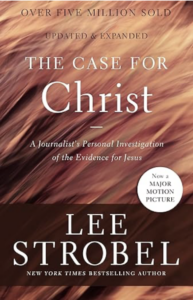
The book, The Case for Christ by Lee Strobel below lays this out beautifully.
Why Did Jesus Come?
The message of the Bible begins with a difficult truth:
God gave us Free Will. Free Will brought separation from God through sin (GENESIS 3)
No amount of good works, kindness, religion, or effort can erase that separation (sin). It requires and is freely given when we accept Jesus Christ as our savior and through the grace of God.
God didn’t wait for us to reach Him.
He Came To Us
Jesus did not come to judge us (judgement comes from God), he came to demonstrate unconditional love and offer us forgiveness through grace and life everlasting. WHAT IS THE TRINITY?
He willingly died on the cross (the most brutal of deaths) for our sins in the ultimate act of love. WHAT IS THE CRUCIFIXION
Three days later, He rose from the dead, defeating death and absolving the sin for all who accept and believe in Him.
His resurrection Is The Ultimate Victory Over Death (Evil)
Unclean spirit (Evil) does not know love (1 John 4:8). Evil claimed victory with the death of Jesus. However, Evil did not anticipate the Risen Christ, because it was the ultimate act of love. Through this act of love and the resurection of Christ, Evil was decisively defeated…forever (Hebrews 2:14). Isaiah 54:17 “No weapon forged against you will prevail.”
Can We Trust the Story?
This is an important question.
Belief in the Bible isn’t based on blind faith.
NOTE: There is a big difference between believing in the Bible and believing in organized religion. The Bible is God’s Word. It is the “Living Word.” Religion is Man’s Dogma (man made beliefs). Read and study the bible for yourself. The more you put into studying God’s Word the more you receive from it. CHRISTIANITIES BIRTH
Jesus existed and lived in a real place, at a real time in history. His life, death, and resurrection have been examined for centuries by historians, archaeologists, scholars, skeptics, and believers alike. There exists many Roman documents detailing events regarding the life of Jesus. There was much at stake for a Roman governor. Documentation was a way to protect themselves from the wrath of Rome.
If you’re skeptical—or simply want to explore the evidence—we encourage you to investigate for yourself in these well thought out resources:
- The Case for Christ by Lee Strobel (investigative journalist, lawyer, and former atheist)
- Mere Christianity by C.S. Lewis
- Cold-Case Christianity by J. Warner Wallace
- The Reason for God by Timothy keller
The Case for Christ ✝
Why we recommend this book? Often times people approach God from their mind’s perspective and try to rationalize and use logic to determine their beliefs (or lack thereof). Often our beliefs are shaped by perception and untruths. Learn how one atheist set out to prove his wive wrong and ended up one of Gods most dedicated believers. Lee Strobel (lawyer, former legal reporter for a National publication, former atheist, and now born-again Christian), does a beautiful job in making the case for why both the bible and its content is real. He set out to disprove Christ and instead became born-again. We invite you to learn why.
— The Journey from Atheist to Born Again and Why —
” Is there credible proof that Jesus of Nazareth really is the Son of God?”
“My wife became a Christian and I wanted to prove her wrong.”
Lee Strobel: Former Lawyer, Atheist, Legal Editor, and Skeptic — and now Christian Pastor at Woodlands Church
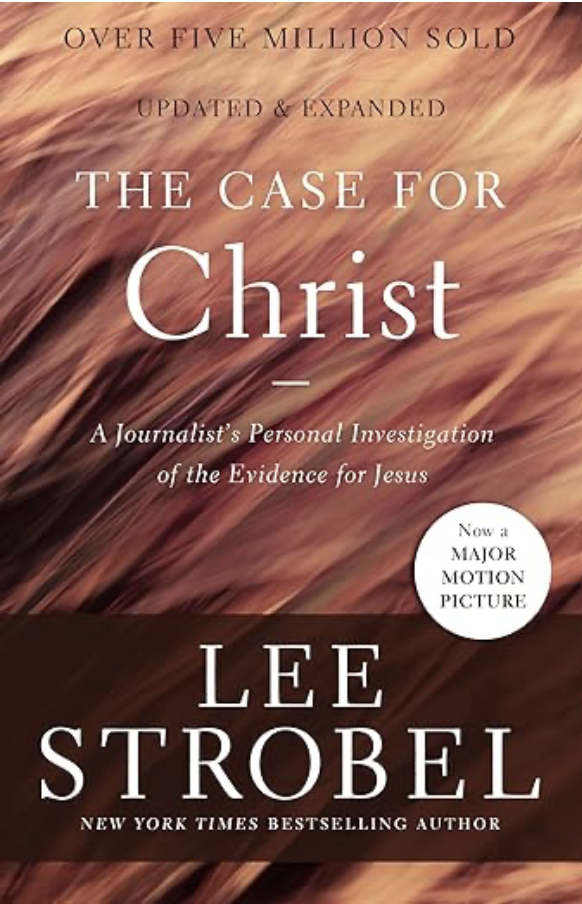
The Case for Christ
In The Case for Christ, Lee Strobel, former legal editor of the Chicago Tribune and New York Times bestselling author, retraces his own spiritual journey from atheism to faith and builds a captivating case for Christ's divinity.
What Does Following Jesus Mean?
Following Jesus IS NOT joining a religion!
It IS NOT about becoming “good enough” or sinless.
It begins with recognizing our need for God.
Trusting that Jesus died for the foregiveness of our sins.
Beliving He Is Risen
Choosing to follow Him. He is very much alive today!
The Bible calls this being born again”—the beginning of a completely new life in Christ that includes the forgiveness of our sins and life beyond this one in Heaven. BORN AGAIN
A Personal Invitation
Jesus Never Foreced Anyone to Follow Him. He invited them.
That invitation still stands today.
If you’ve never taken time to honestly consider who Jesus is, we encourage you to begin that journey.
Read one of the Gospels.
Ask difficult questions.
Seek the truth with an open heart.
God promises that those who sincerely seek Him will find Him.
Ya But…
What are the gospels?
Answer: The word Gospel means “Good News.” In the bible, the first four books of the New Testament are considered the Gospel. They are the books of Matthew, Mark, Luke, and John. Each of these were dicipels of Jesus. BIBLE
Bible language can be hard to understand. How can I understand it?
Answer: The original Bible text was written in the popular languages of the day—Hebrew, Aramaic, and Greek. There are many translations into english available. Each version has a perspective or basis of translation. The Modern English Version (MEV) is a good place to start. It uses modern english and offers thought-for-thought translation to get the original thought through.
How can I have a relationship with Jesus?
Answer: Jesus has risen. Meaning He is alive and well. A relationship with the risen Christ is as close as “asking for one.” Jesus desires a relationship with you. Since he does not force a relationship upon anyone, He awaits for your asking. Proclaim your desire for a relationship and ask Him to reveal Himself to you.
Don’t expect fire and brimstone or the Heavens to open. Do expect a thought or whisper in you mind. The more you quiet the chatter of your normal mind (ego), the easier it is to hear the voice of the Lord. The best approach is to keep asking and keep listening. Keep paying attention to the small positive things in life. As your faith grows, so does your relationship.
.
God’s great love for you cannot fit into any sized box!
God loves you more than you love yourself!
Understanding Jesus naturally leads to understanding God’s Word.
The Bible isn’t just an ancient book—it tells one unified story of God’s love, redemption, and His plan for humanity.
God’s Word
The Crucifixion
Rome reserved crucifixion for the worst of the worst criminals.
It was the most brutal process to torture and kill someone.
Jesus was not found guilty of anything, but Pontius Pilate actually wanted to let him go free. The customs of the day allowed for the release of a prisoner on Passover. Pilate offered the crowd a choice between releasing a criminal named Barabbas or Jesus. They chose to release Barabbas and have Jesus curcified even though he had not been found guilty of anything against Rome.
Let Him be crucified! they yelled.
Pilate bowed to political pressure.
God’s only Son was brutally crucified.
Thereby fulfilling the scriptures of the Old Testament.
The Roman historian Tacitus, writing in the early second century, recorded that Christus—the founder of Christianity—“suffered the extreme penalty” during the reign of the Roman emperor Tiberius at the hands of Pontius Pilate. Tacitus was not a Christian and wrote about Christians with considerable hostility.
Fulfilling the Old Testament
Isaiah 53:3
“He is despised and rejected by men, A man of sorrows and acquainted with grief.”
Isaiah 53:4
“Surely He has borne our griefs and carried our sorrows.”
Zechariah 12:10
“And they will look on Me whom they pierced.”
Exodus 12
“Nor shall you break one of i ts bones.”
Before being taken to the cross, Jesus was scourged by Roman soldiers. The scourging was brutally severe, with a Roman whip designed to tear the flesh. The soldiers then placed a crown of thorns on His head, struck Him, spit on Him, and mocked Him as “King of the Jews.” [Isaiah 50:6; Isaiah 53:3–5; Psalm 22:7–8]
Jesus was then forced to carry His cross toward Golgotha. Weakened by the beating, He eventually could not continue, and Simon of Cyrene was compelled to carry it for Him. [Isaiah 53:7]
At Golgotha, Jesus was nailed to the cross through His hands and feet and lifted up between two criminals. The soldiers divided His clothing among themselves and cast lots for His garments, fulfilling the words written in Psalm 22:16–18.
Those watching mocked Him. Religious leaders, soldiers, and even one of the criminals insulted Him, challenging Him to save Himself. [Psalm 22:7–8] Yet Jesus did not retaliate or call for rescue. He prayed for those crucifying Him: “Father, forgive them, for they do not know what they do.”
Darkness covered the land. Jesus cried out, “My God, My God, why have You forsaken Me?” — the very words written centuries earlier in Psalm 22:1.
Jesus became thirsty, and He was given sour wine to drink, fulfilling Psalm 69:21. After hours on the cross, Jesus declared, “It is finished.” Then He said, “Father, into Your hands I commend My spirit,” echoing Psalm 31:5, and He died.
The soldiers came to break the legs of those being crucified to hasten their deaths. They did not break Jesus’ legs, because He was already dead. This fulfilled Psalm 34:20 and the Passover instruction concerning the lamb in Exodus 12:46.
Instead, one of the soldiers pierced Jesus’ side with a spear, and blood and water flowed out. [Zechariah 12:10]
Jesus was taken down from the cross and placed in the tomb of Joseph of Arimathea, a wealthy man. [Isaiah 53:9]
The crucifixion was not simply an execution. Christians believe that Jesus willingly endured this suffering for our sins, fulfilling the picture of the suffering Servant described in Isaiah 53:5–6:
“He was wounded for our transgressions, He was bruised for our iniquities.”
And then, three days later, the tomb was found empty.